
 О нас
О нас
 Условия использования
 Конфиденциальность
Five Reasons for the Adoption of Representative Democracy in Nigeria
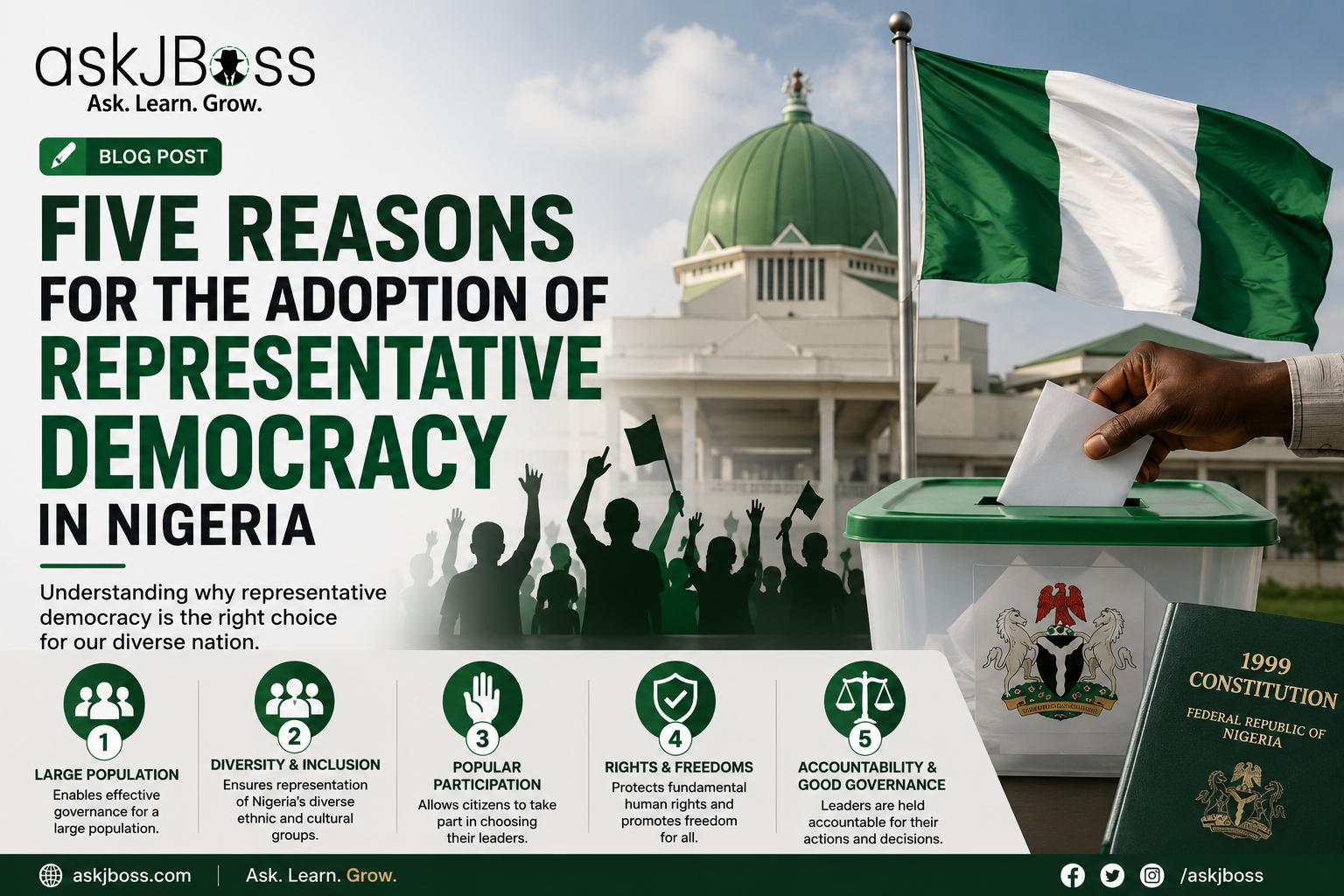
Five Reasons for the Adoption of Representative Democracy in Nigeria
Introduction
Representative democracy is a system of government in which citizens elect representatives to make decisions and govern on their behalf. Nigeria practices representative democracy, allowing citizens to participate in governance through periodic elections.
Since returning to democratic rule in 1999, Nigeria has continued to strengthen its democratic institutions and processes. But why was representative democracy adopted in Nigeria? This article explores five major reasons behind its adoption.
1. Large Population Size
Nigeria is the most populous country in Africa, with over 200 million people spread across 36 states and the Federal Capital Territory.
In a country with such a large population, it is practically impossible for every citizen to participate directly in every government decision. Representative democracy provides a practical solution by allowing citizens to elect leaders who represent their interests at different levels of government.
This system ensures that governance remains efficient while still reflecting the will of the people.
2. Diverse Ethnic and Cultural Groups
Nigeria is home to more than 250 ethnic groups with different languages, cultures, and traditions.
Representative democracy allows these diverse groups to have a voice in government through elected representatives. It promotes inclusiveness by ensuring that different regions, ethnic groups, and communities are represented in decision-making processes.
This helps foster national unity and peaceful coexistence among Nigeria's diverse population.
3. Promotion of Popular Participation
One of the key principles of democracy is citizen participation in governance.
Representative democracy gives Nigerians the opportunity to choose their leaders through elections. Citizens can vote, contest for public office, join political parties, and contribute to national discussions.
This participation strengthens democratic values and ensures that government remains accountable to the people.
4. Protection of Citizens' Rights and Freedoms
Representative democracy is built on the rule of law, constitutional governance, and the protection of fundamental human rights.
Through elected representatives and democratic institutions, citizens enjoy freedoms such as:
-
Freedom of speech
-
Freedom of association
-
Freedom of religion
-
Freedom of the press
-
Right to vote and be voted for
These rights are essential for maintaining a free and democratic society.
5. Accountability and Good Governance
Representative democracy creates mechanisms through which leaders can be held accountable for their actions.
Elected officials are expected to serve the interests of the people. If they fail to perform, citizens have the power to vote them out during subsequent elections.
This accountability encourages transparency, responsiveness, and responsible governance. It also motivates leaders to implement policies that improve the lives of citizens.
Conclusion
Nigeria adopted representative democracy because it is a practical and effective system for governing a large and diverse population. It promotes citizen participation, protects fundamental rights, ensures representation for different groups, and encourages accountability among leaders.
Although challenges remain, representative democracy continues to play a vital role in Nigeria's political development and nation-building efforts. By actively participating in the democratic process, citizens can contribute to building a stronger, more prosperous, and more united Nigeria.
Author: AskJBoss.com
Category: Politics & Civic Education
Tags: Democracy, Nigeria, Representative Democracy, Civic Education, Government, Politics, Citizenship

 English
 Arabic
 French
 Spanish
 Portuguese
 Deutsch
 Turkish
 Dutch
Dutch
 Italiano
 Romaian
 Portuguese (Brazil)
 Greek
Greek